Hello everyone, and thank you for holding space for something deeply personal and I believe, deeply important.
I want to talk about psychosis. But not as a diagnosis or disorder.
Not as a flaw in the brain.
I want to talk about it as a response, a meaningful one.
For me, psychosis wasn’t a collapse.
It wasn’t senseless.
It was a breakthrough of meaning. A way of surviving in a world that often felt unsafe.
I didn’t have the language for this while I was in it.
But later, I came across something called the Power Threat Meaning Framework.
And while it wasn’t part of my recovery at the time, it gave shape to what I had already lived.
It mirrored what I had slowly come to understand on my own.
What This Framework Offers
The PTMF was developed by the Division of Clinical Psychology of the British Psychological Society, not just by clinicians, but alongside people with lived experience.
It doesn’t ask, “What’s wrong with you?”
It asks:
What has happened to you?
How did it affect you?
What sense did you make of it?
What did you do to survive?
These questions shifted my life from feeling like a broken diagnosis, to being seen as a human being with a story.
Why Diagnosis Didn’t Help Me
For years, I was told my mind was broken. That psychosis was a glitch. A medical malfunction.
But that explanation never fit.
It didn’t explain the bullying I went through.
It didn’t account for the isolation, the loneliness that felt like it followed me everywhere.
It didn’t explain why the voices I heard sounded so much like the people who had hurt me, or why they knew my deepest fears.
That model erased the context of my life.
But this other way of understanding gave me permission to see my experience not as an illness but as a response to a world that had, in many ways, failed to protect me.
What I Came to Understand
Looking back now, here’s what I believe:
- Our lives, to an extent, are shaped by power, how it’s used, how it’s withheld, how it’s abused
- When we experience harm, abuse, neglect, exclusion, we don’t just forget it. We carry it.
- The mind finds ways to make sense of what’s happening, even if those ways look strange from the outside
- And often, our most painful responses, hearing voices, holding unusual beliefs, are actually acts of survival
This perspective doesn’t ignore biology. But it doesn’t put it on a pedestal either.
It places it in context alongside culture, trauma, relationships, and meaning.
My Story – Power and Survival
When I reflect on my own experience with psychosis, I now see it, to a great extent, through the lens of power.
Much of my early life was shaped by coercion and fear.
I was bullied. Made to feel small. Constantly on guard.
Later, the voices I heard weren’t mysterious, they were familiar.
They echoed those early threats, replaying them in a new form.
I also experienced a deep lack of interpersonal connection.
I often felt invisible. Like my existence didn’t register.
And those unmet needs didn’t go away, they took shape.
They spoke to me. They became part of my inner world.
When I later learned that these kinds of experiences often give rise to what we call “psychosis,” it made perfect sense.
It wasn’t random. It was my mind expressing pain the only way it knew how.
Systemic Power and Internalized Messages
Then there are the bigger systems, poverty, ableism, psychiatric stigma.
I lived under the weight of those too.
And when you’re told over and over that you’re dangerous, broken, or “other,” that message gets in.
Eventually, it doesn’t just affect your thoughts, it affects how you experience reality.
Naming those forces didn’t fix everything.
But it helped me stop blaming myself for things that were never mine to carry.
The Fable: The North Wind and the Sun
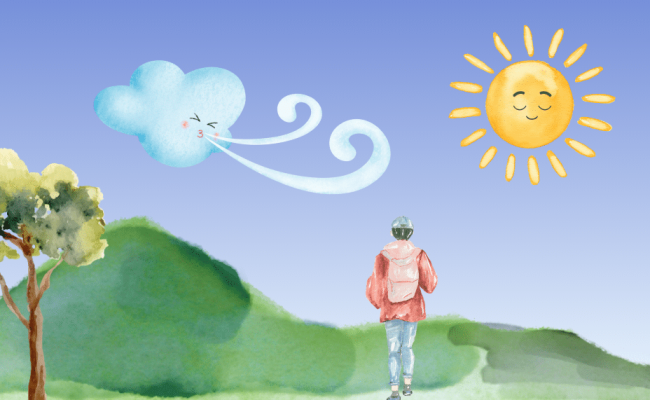
There’s a story I love that captures all of this. It’s an old fable, The North Wind and the Sun.
In the story, the Wind and the Sun argue over who is stronger.
To settle it, they challenge each other to get a traveler to remove his cloak.
The Wind goes first, blowing hard, trying to force the cloak off.
But the harder it blows, the more tightly the traveler clutches the fabric.
Then it’s the Sun’s turn.
It doesn’t push.
It just shines gently, warmly.
And slowly, the traveler relaxes.
He loosens the cloak.
And eventually, he takes it off on his own.
That’s what my psychosis was: a cloak.
Something I wore for protection.
Something I needed, until I didn’t.
And what helped me wasn’t force. It was warmth.
It was people showing up with curiosity instead of control.
With understanding instead of urgency.
When clinicians acted like the Wind, diagnosing, pressuring, pathologizing, I held on tighter.
But when someone showed up like the Sun, patient, present, human, I started to feel safe enough to let go.
Relational Safety
This kind of safety isn’t just a therapeutic strategy. It’s a way of being.
It sounds like:
“I believe you.”
“I want to understand your experience.”
“Your pain makes sense.”
That kind of connection doesn’t just soothe, it transforms.
It replaces power over with power with.
And that shift can change lives.
Reclaiming My Power
Recovery for me didn’t mean erasing psychosis.
It meant understanding it.
It meant seeing myself not as a broken brain, but as someone who adapted, who survived.
That understanding helped me take back my power.
It helped me find meaning in what had once felt like chaos.
And it gave me the language to rewrite a story that had been written about me, without me.
I began asking new questions:
- What threats did I face?
- What was I trying to survive?
- What meaning can I find now?
- And how do I want to live, even with ongoing challenges?
So, I leave you with this:
In our systems of care, our classrooms, and our communities
Are we acting like the North Wind?
Pushing. Diagnosing. Controlling.
Or are we willing to be the Sun?
Warm. Curious. Patient. Human.
Because sometimes the cloak, the beliefs, the voices, the distress
don’t fall away with pressure.
It falls away
when the warmth is enough.
Thank you.
Written by Justin McDermott